
As safety professionals grapple with the rapid evolution of AI in EHS, it can be difficult to know what adoption actually looks like across the field. Organizations are approaching the technology in different ways and moving at different speeds.
New research from the American Society of Safety Professionals (ASSP) provides a benchmark. Based on a survey of nearly 1,000 safety professionals, the report, Trust, Ethics and Governance: How Safety Leaders Are Thinking About and Using AI, identifies five stages of AI-EHS adoption and examines how organizations' experiences change as they move along that path.
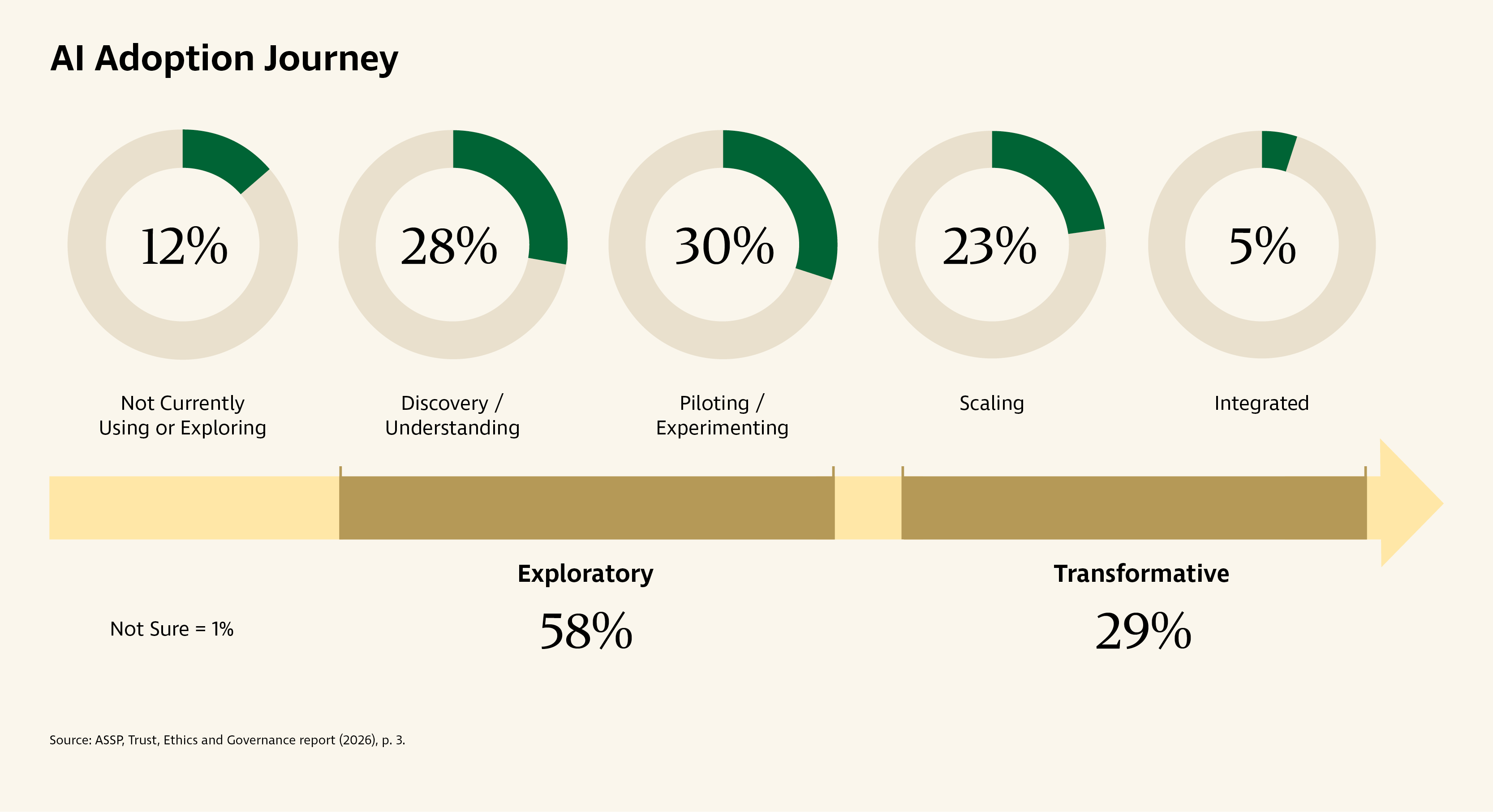
Today, just 5% of organizations have reached the point where AI is fully operationalized and integrated across departments and teams. But 1 in 5 expect to get there within two years.
Understanding the stages of that journey can help safety professionals see where their organization fits today and what they may encounter as AI adoption moves into the future.
What Does the AI-EHS Adoption Journey Look Like?
AI adoption is not a single decision or technology implementation. Organizations progress as they learn about AI, test specific applications, expand successful uses and eventually integrate the technology more broadly into their operations.
The report identifies five stages along that journey.
1. Non-Adopters: Not Currently Using or Exploring AI for EHS
About 12% of organizations are not currently using or exploring AI for EHS.
Organizations at this stage may have little experience with AI or may not yet view the technology as a priority for their EHS programs at all. In fact, only 15% of non-adopters consider AI critically or very important to the success of their EHS programs.
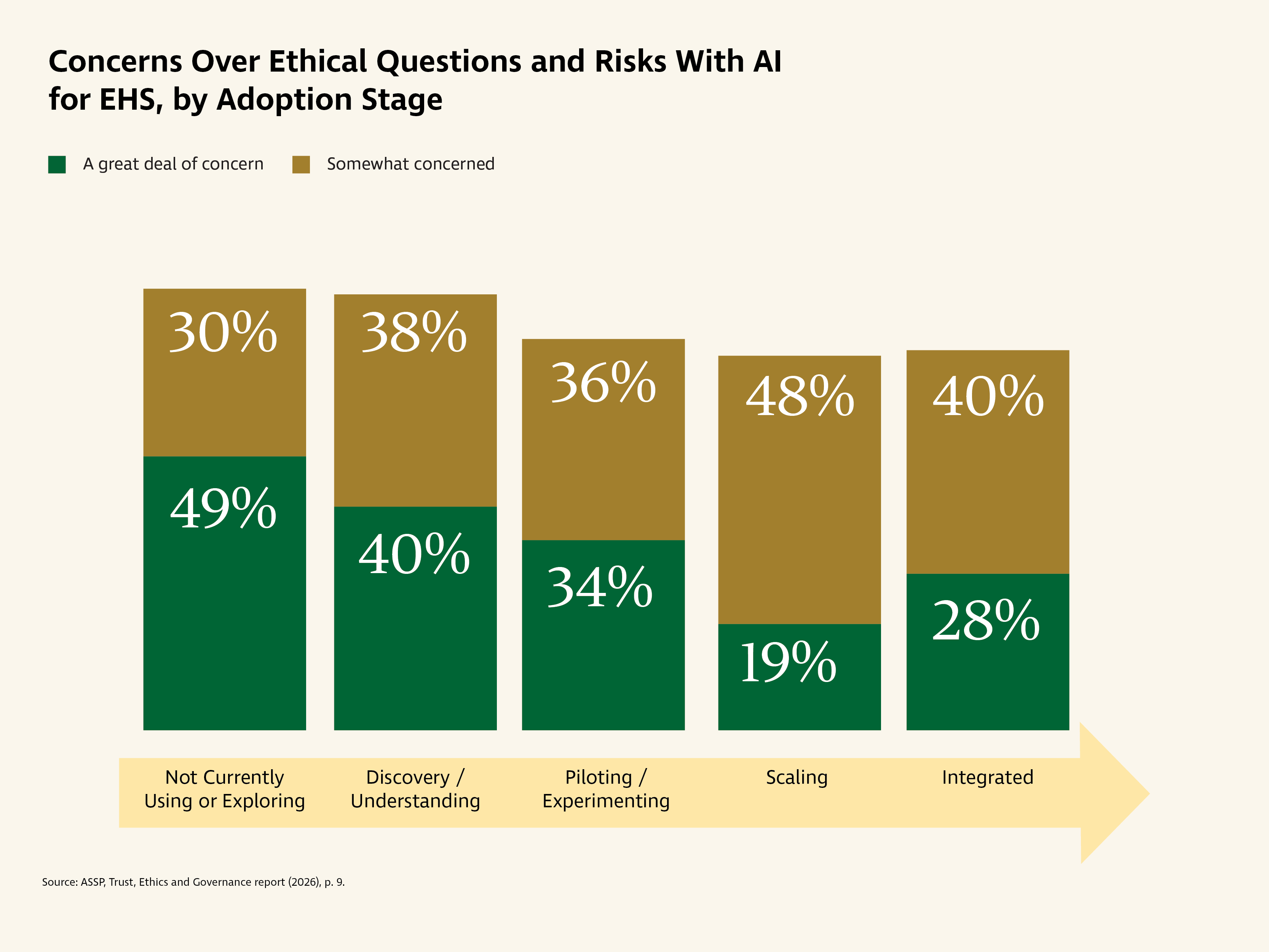
This group also reports being most concerned about the ethical implications of AI. About half express a great deal of concern about ethical questions and risks associated with using AI for EHS.
2. Discovery/Understanding: Exploring What AI Could Do
Another 28% of organizations are in the discovery and understanding stage. They are learning how AI works and exploring potential tools and use cases but have not yet moved into significant experimentation.
At this point, organizations are beginning to consider where AI fits into EHS operations. Nearly 3 out of 10 safety professionals at organizations in the discovery stage consider AI critically or very important to their EHS programs, almost twice the share among non-adopters.
3. Piloting/Experimenting: Putting AI to the Test
Piloting and experimenting is currently the most common stage, encompassing 30% of organizations. These organizations are often running a limited number of pilot projects focused on narrowly defined use cases.
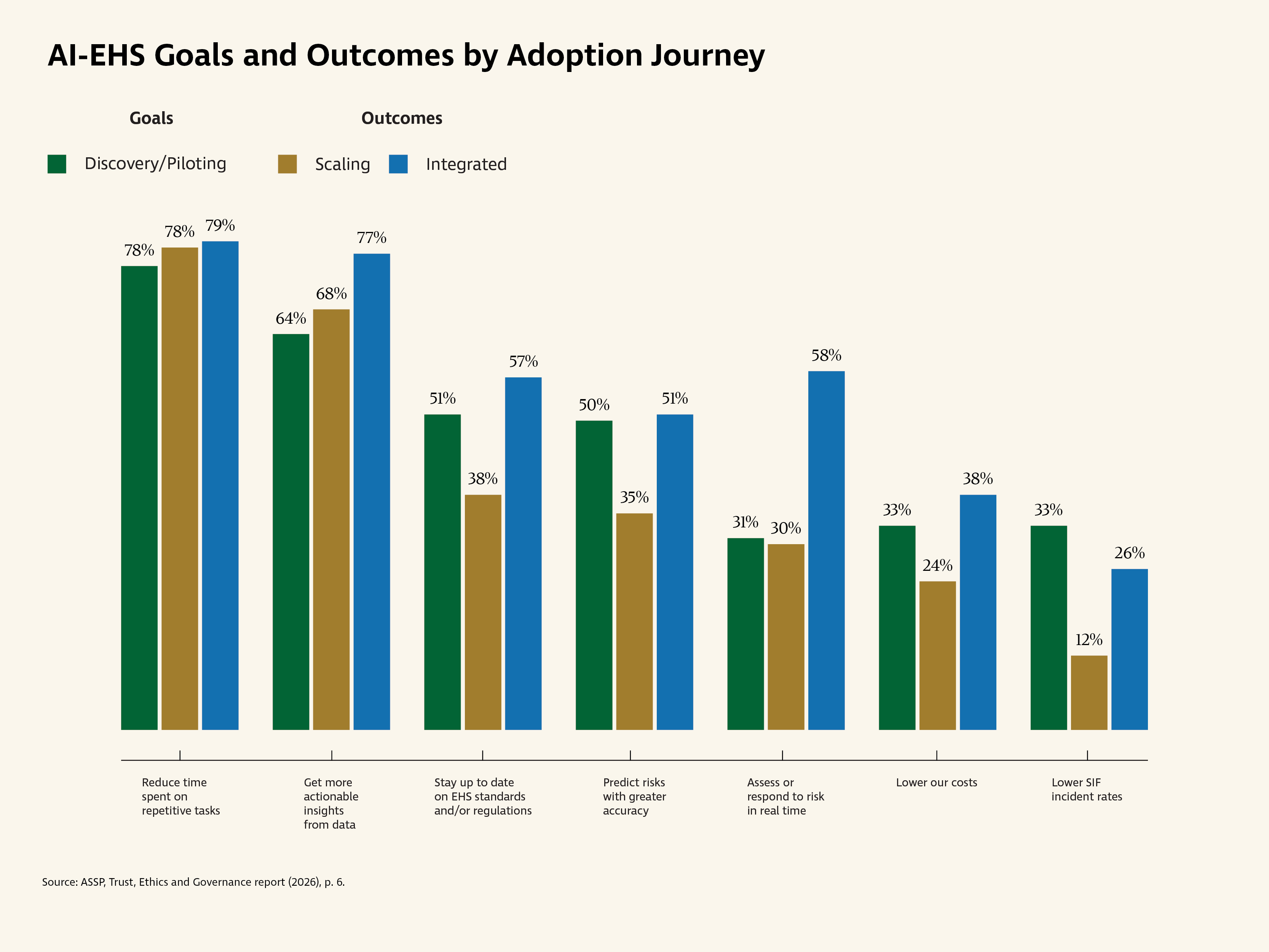
At this stage, they may even begin seeing some value in AI tools or processes they have implemented so far. Some of the earliest applications involve practical tasks such as report development and tailored education and training. Some tangible benefits like reduced time spent on repetitive tasks and more actionable insights from data begin emerging.
4. Scaling: Expanding AI Across the Organization
About 23% of organizations have reached the scaling stage, where AI is being applied more widely to support strategic business objectives.
At this stage, organizations are moving beyond isolated use cases. As AI becomes more embedded in EHS operations and begins informing more complex decisions, organizations are more widely considering governance structure, improving data quality and writing policies about use and ethics. However, organizations at all levels still have gaps in these areas.
5. Integrated: Making AI Part of EHS Operations
Only 5% of organizations currently report being fully integrated, meaning they have operationalized AI and integrated it across departments and teams.
Organizations at this stage are reporting some of the more advanced outcomes associated with AI, such as predicting risks with greater accuracy, assessing and responding to risk in real time and staying up to date with EHS standards and regulations.
Integration does not mean every challenge has been resolved, however. Data quality remains a barrier, gaps in AI-specific training remain and ethical concerns persist, particularly when AI begins to influence decisions that affect SIF risks and worker discipline.
The entire progression takes time. Two-thirds of organizations began their AI-EHS journey within the past 18 months, and organizations typically take one to two years to move from discovery and experimentation toward scaling and integration.
What Changes as AI Adoption Matures?
Moving through the five stages involves more than simply adding AI tools. ASSP's research shows differences in comfort level, governance and organizational readiness as AI use matures.
● Confidence grows with experience. Safety professionals become increasingly comfortable interpreting AI-generated metrics as their organizations gain experience with the technology. That comfort rises from 54% among organizations in discovery to 73% in piloting, 87% in scaling and 98% among integrated organizations.
● Governance becomes more established. Organizations tend to add more guardrails as AI use expands: 62% of integrated organizations have AI-EHS ethics policies or guidelines compared with 20% of organizations in discovery. Yet gaps remain across the profession: Nearly half of organizations do not have AI ethics policies.
● Training, though still limited, builds knowledge and confidence. Safety professionals who have attended AI training report greater AI knowledge, greater comfort interpreting AI-generated metrics and a greater perceived impact of AI on safety decision-making. Yet about 2 out of 5 EHS professionals have received no formal AI training.
Where are safety professionals seeing the most value from AI? What concerns them most? And where do they believe human oversight remains essential? Download the report.
Where Is Your Organization on Its AI-EHS Journey?
To help safety professionals understand the range of AI adoption across the field, ASSP's research groups organizations in the discovery and piloting stages as exploratory and those in the scaling and integrated stages as transformative.
The table shows how some of those characteristics differ between exploratory and transformative organizations and can help you consider where your organization falls along the journey.
| Ask yourself | Exploratory organizations | Transformative organizations |
|---|
| | Discovery/ Understanding | Piloting/ Experimenting | Scaling | Integrated |
| How important is AI to EHS success? | AI is considered somewhat important and is gaining momentum in importance. | AI is more likely to be considered very or critically important to EHS success. |
| How comfortable are you using AI-generated metrics for EHS? | Safety professionals are not too or not at all comfortable at the beginning, but move toward great comfort as the process goes on. | Comfort builds quickly, from about half of professionals in discovery to nearly three-quarters in piloting. |
| How concerned are you about AI ethics? | Ethical concerns tend to be more pronounced; a large majority feel a great deal or somewhat concerned about AI for EHS. | Ethical concerns tend to be lower, shrinking to a majority feeling somewhat or not too much concerned, though they do not disappear as more than a quarter still have a great deal of concern. |
| How established is AI governance? | Policies, strategies and governance may still be developing; only about a third of these organizations have them. | AI-EHS governance, policies and strategies tend to be more established; about half to two-thirds of these organizations have them. |
| How would you rate your data quality? | Only about a third rate their data quality as good or excellent, and organizations collect fewer types of data. | More than half to 70% rate their data quality as good or excellent, though it remains a barrier. More types of data are collected. |
| How much AI knowledge and training do you have? | Professionals consider themselves not too knowledgeable or somewhat knowledgeable. About half have attended training | Professionals primarily consider themselves somewhat or very knowledgeable. A large majority have attended training. |
| How long have you been using AI for EHS? | Organizations tend to be earlier in their AI journey, primarily having started within the past year. | Organizations often have one to three years or more of AI experience. |
| | | | | |
Explore the complete research to see where organizations are today, how AI adoption is evolving and what safety professionals are learning along the way. Download the report.